
 Clinical Research Hub Contact us 2-Page Overview Overview
 Why the Checklist
01Expertise is not what prevents missed steps in complex work; a checklist is. What goes in one, and where it lives, decides whether the work gets done.
No matter how many hours a pilot has logged, you would not want to board a flight where they skipped the pre-flight checklist. Experience alone is not what keeps the plane safe; the checklist is what catches the one item a tired, distracted, or rushed expert would otherwise miss.
The same lesson turns up wherever the work is complex and the stakes are high. In The Checklist Manifesto, the surgeon Atul Gawande names why: the failures that hurt us in such work are rarely failures of knowledge but failures to apply what we already know.1
To close that gap, Gawande’s team took the idea from the cockpit into the operating room. Their surgical safety checklist cut major complications by 36 percent and deaths by 47 percent, in operating rooms already run by trained surgeons. It made no one a better clinician; it made sure the clinician did what they already knew to do, every time.
Clinical trials live squarely in that world: heavily regulated, unforgiving of small omissions, run by experienced people managing more complexity than any one mind can hold at once, and — as in the operating room — with a patient on the other side of every step that gets missed.
What does the work is structure: the steps made explicit and ordered, so that following them is not left to recall. A checklist is the form that structure takes when the work is a sequence someone has to get through, which is why it has been one of the coordinator’s essential tools, and why it endures.
What a checklist actually does for a coordinator
Beyond bringing the work together in one place, a good checklist changes how the person doing it is able to think. The points that follow draw on Michelle Gattshall’s account of why checklists matter to research sites.2
It frees the mind for the unexpected. With the routine steps written down, the coordinator no longer has to remember them. That attention is free for what no list can script, the moment that demands judgment then and there: a sudden patient reaction, a mid-procedure equipment failure.
It guards against the missed step. Haste and interruption both make it easy to skip something or misremember that it’s done. The checklist holds your place, confirming each step before you move on: the difference between “I think I recorded that” and knowing.
It standardizes the work. The whole team works from the same checklist: a new hire can be brought up to speed on it, a reviewer can verify it was followed, and if a staff member leaves mid-study, the knowledge does not leave with them.
It surfaces risk before it happens. Building a checklist forces you to think a process through, to find the precursor everyone forgets, the deviation waiting to happen. The mitigation goes on the list, and the deviation never occurs.
None of this is theoretical, and none of it is easy: a good checklist takes real work to build and to keep current. Building and maintaining one is among the highest-return investments a site can make, because everything above compounds across every visit, every patient, every trial the site runs.
Where the checklist should live
If the checklist is this powerful, the question is not whether a site should use one, but where it should live and what belongs in it. What belongs in it is everything a visit requires, drawn from many sources: the protocol, the manuals, your SOPs and your training material, and the site’s own procedures and hard-won practices.
Today what a visit requires is scattered: parts in the CTMS, parts in the eSource system, some kept in Word, Excel, or on paper, and the rest carried only in memory. Each holds only a slice, so every visit the coordinator has to piece together what to do, and whatever slips past is a step that doesn’t get done. Comprehensiveness is not a nicety here: it is the difference between knowing the visit is fully done and hoping it is.
CRC-Hub: the one place it lives
CRC-Hub is a coordinator’s tool built around the checklist. Every other system the coordinator uses was built for a different purpose: sponsor oversight, data capture, reporting. CRC-Hub makes the checklist its foundation: where what a trial requires becomes what to do.
Here is what that foundation looks like: a single visit’s checklist, as a coordinator builds it in CRC-Hub’s designer.
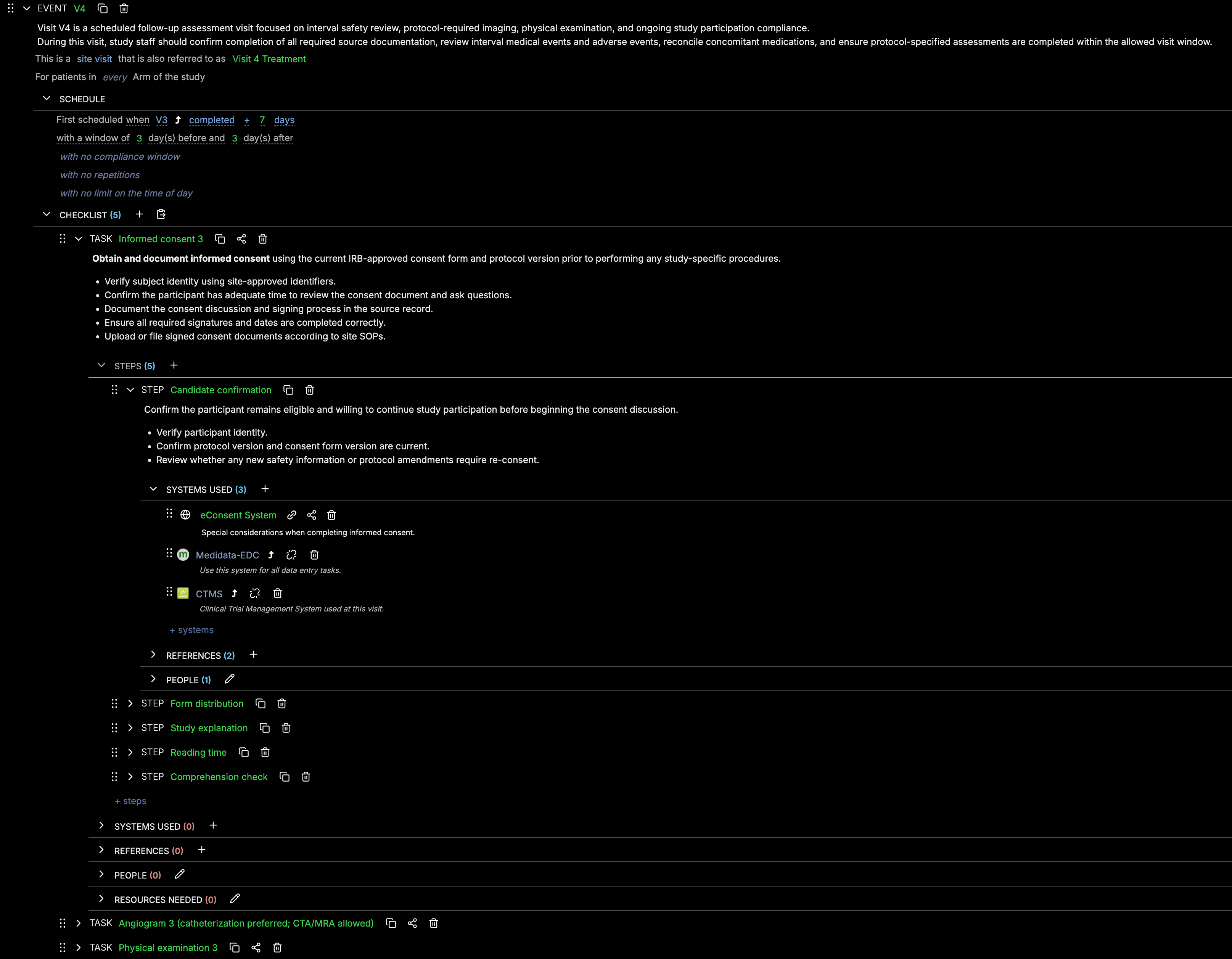
Everything a coordinator needs from a checklist is here, in one view. The visit begins with its schedule, so the work is anchored to when from the start, not left to a separate system. Below it, the visit is broken into tasks, and each task into concrete steps, the routine mapped out so the mind is free for the exception. The steps are ordered and explicit, so nothing depends on remembering where you were. And each step carries the systems, documents, and people it requires, linked right where the work happens, so there is no hunting across logins and folders — along with the site’s own know-how, how this sponsor reads eligibility criterion 7 or how the courier works here, attached to the step it belongs to, where a colleague picking the study up mid-trial will find it.
This is the whole of what a visit demands, drawn from every source that defines it and made explicit in one place.
More than a checklist
The checklist is the foundation. Everything else CRC-Hub does is in service of making it work in a real trial.
Setup that is finally fast. Building checklists has always been the painful part, the reason so many stay thin or out of date. CRC-Hub uses AI to read a trial’s documents — the protocol, the manuals, your SOPs and your training material — and draft the full checklist. The coordinator then reviews and adjusts it. Comprehensive checklists take minutes instead of hours.
A trial, not just a visit. Every visit’s checklist is scheduled: when it happens, how far it can flex, which visit it follows. Together they form one connected trial, each visit aware of the ones around it.
The checklist as a hub. Each task and step links to what it requires: the system to open, the document to reference, the person to reach, right when the work calls for them. That is the hub — everything the work needs, brought to the checklist instead of hunted down. It links out rather than copying: the clinical record stays in eSource and the financial record stays in the CTMS, so CRC-Hub is where the work is run, not a second place to type the same fact.
On the calendar, at the visit. CRC-Hub puts each visit’s checklist on the calendar, with “what to do” anchored to “when,” so the coordinator opens it from the visit and completes it there. Each step is checked off and any notes recorded on the checklist itself, as the visit happens.
Booked against roles and resources. A visit’s checklist records what the visit takes: the staff, the room, the equipment, a rater certified on that instrument, and for how long. CRC-Hub schedules against all of it in fifteen-minute blocks, with the option to constrain who can be assigned by your delegation of authority, so a clash or an undelegated task is caught at booking rather than on the morning.
Everything still open, in one list. Steps stay live until they are done, with an owner and a date, whether the visit has happened or not. Anything else is added in a line — a call to make, records to chase, a reconsent due before the next visit, an approval waiting on the IRB — and attaches wherever it belongs: to a step, a visit, a patient, a study, or to nothing at all. It all reaches the same list, on the day it matters.
Versioned and audit-ready. Amendments publish as controlled major versions, migrated per patient, so different patients can be on different versions and each one moves deliberately rather than all at once. Day-to-day site refinements apply immediately. Every visit records exactly which version it was run under, and every version is kept in full.
Other systems do pieces of this, but each holds only a slice. Only CRC-Hub puts the complete checklist at the center and builds everything needed to run a trial around it, for the coordinator and the whole team.
What the site gets back
Fewer missed steps, and fewer of their consequences. The visit that has to be repeated, the timepoint that can’t be recovered, the deviation to write up and answer for at the next monitoring visit — each of these starts as one small step that nothing held. A checklist that holds all of them, on the calendar and ticked off as the visit runs, is the mechanism that stops them.
The patient gets the whole visit. What changed in Gawande’s operating rooms was not the surgeons but whether every step got done, every time. In a trial the equivalent is the safety assessment made, the eligibility criterion checked, the sample that ships in time — and the patient who is not called back because a visit has to be run again.
The know-how stays with the site. When a coordinator leaves, what leaves with them is how this sponsor reads criterion 7 and how the courier works here. In CRC-Hub that sits on the step it belongs to rather than in one person’s head or their private worksheet, so the handoff is the working study itself, and the next coordinator starts from it rather than rebuilding it.
Ready for the monitor, without preparing for them. Every visit records the version it was run under, and every version is kept in full. Whether a step was followed, and under which amendment, is a fact to look up rather than a reconstruction after the fact.
Time back, where a site feels it. The checklist that took hours to build takes minutes. The visit that took a hunt across four logins takes one screen. Both compound across every visit, every patient, every trial the site runs.
The fastest way to judge any of this is to see it built from real documents. Send us what defines a study — the protocol, the manuals, SOPs and training material, and any checklists that go with it — and we will build the schedule and the checklists for the whole study: CRCHub@triradial.com.
Notes
- 1Atul Gawande, The Checklist Manifesto: How to Get Things Right (Metropolitan Books, 2009). See also “The Checklist Manifesto” (Texas Lean Six Sigma) and this summary.
- 2Michelle Gattshall, “Checking It Twice! Clinical Trials Checklists,” LinkedIn, March 17, 2023.